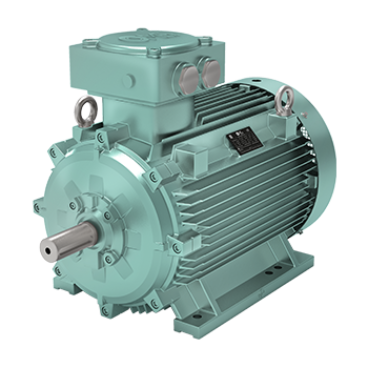
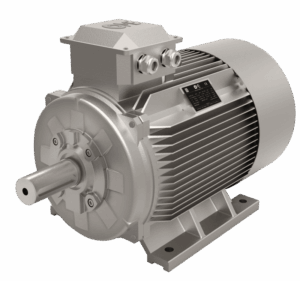
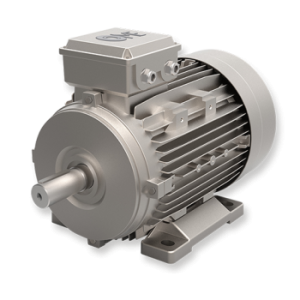
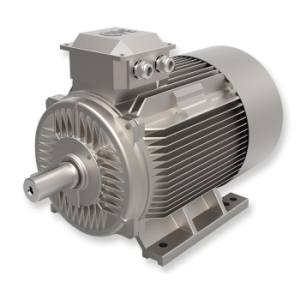
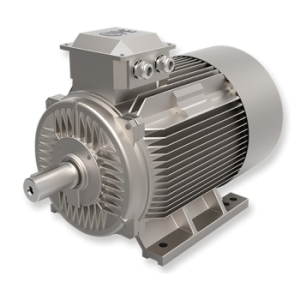
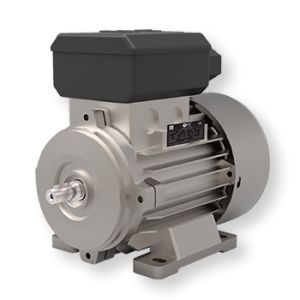
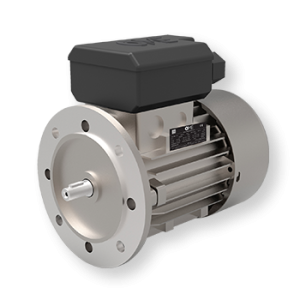
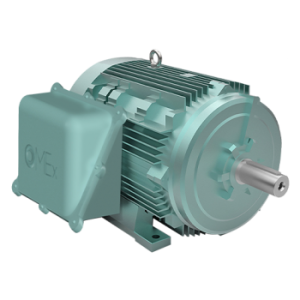
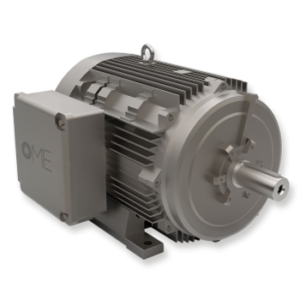
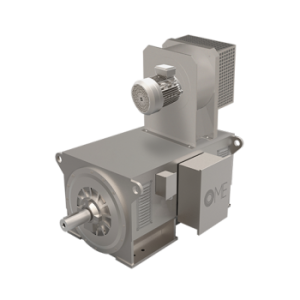
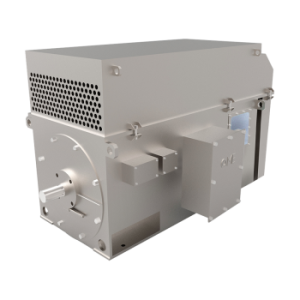
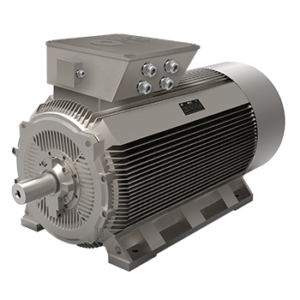
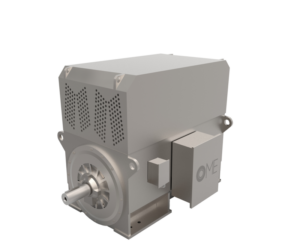
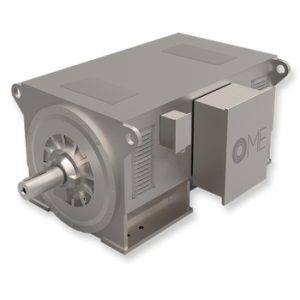
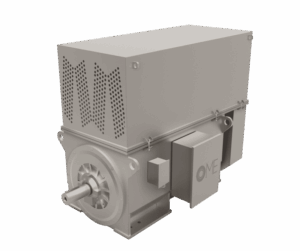
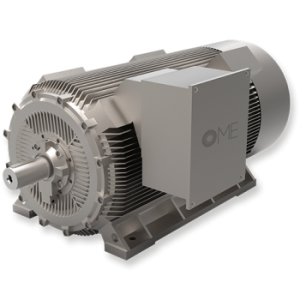
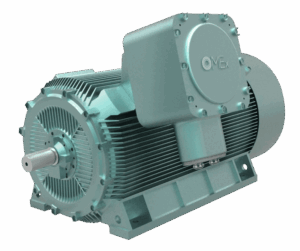
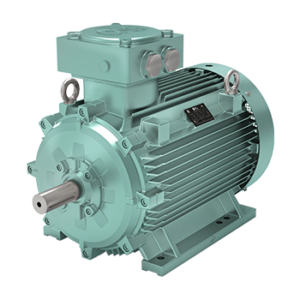
The OMPM series is the OME Motors range of
permanent magnet synchronous motors (PMSM) engineered for industrial applications where efficiency, torque density, and precise speed control define the business case. Compared to a standard induction motor of equivalent rating, an OMPM unit delivers measurably higher efficiency — typically above the IE4 / NEMA Premium threshold — a more compact footprint, and full rated torque from near-zero speed up to base speed. The technology is the reference choice for variable-speed pumps, compressors, fans, and HVAC equipment in industrial plants pursuing energy-reduction targets.
Technology section: At the core of the OMPM motor is a synchronous rotor design with rare-earth magnetic bars permanently embedded in the lamination stack. Rotor flux is supplied by the magnets themselves, removing the magnetizing current draw and the rotor I²R losses that limit induction motor efficiency. The motor is driven by a Variable Frequency Drive (VFD) with vector control — sensorless or encoder-feedback depending on application — and is built to
VSD-Duty standards with reinforced insulation systems that withstand PWM voltage stress.
OMPM motors are available in both
Interior Permanent Magnet (IPM) and
Surface Permanent Magnet (SPM) topologies. IPM construction adds a reluctance torque component that extends the constant-torque speed range and improves performance under field-weakening operation; SPM construction offers a simpler magnetic circuit suited to lower-speed applications.
Permanent magnet motor vs induction motor: The comparison between a permanent magnet synchronous motor and a standard three-phase induction motor reduces to four points. First,
efficiency: PMSM units typically operate 2 to 5 efficiency points above an equivalent NEMA Premium induction motor across the full load curve, with the largest gap at partial load. Second,
torque at low speed: PMSM motors deliver full rated torque from near-zero speed without forced ventilation, whereas induction motors lose available torque below 30% of base speed when driven by a VFD. Third,
footprint: for the same kW rating, an OMPM frame is typically one or two IEC sizes smaller than an induction equivalent. Fourth,
starting: standard PMSMs require a VFD to start, while a Line-Start PMSM variant is available for direct-on-line applications.
Technical specifications block
Applications section (rewritten): OMPM permanent magnet motors are deployed in:
- Pumping systems — water, wastewater, desalination, irrigation
- HVAC equipment — large air handlers, chillers, building ventilation
- Compressors — centrifugal and screw compressors with variable load profiles
- Power generation auxiliaries — boiler feed pumps, cooling water pumps, fan systems
- Food and beverage processing — variable-speed conveyors, mixers, pumps
- Marine and offshore — propulsion auxiliaries, deck machinery, on-board systems
Contact our technical team for application sizing.
Permanent Magnet Motor FAQ
What is the difference between a permanent magnet motor and an induction motor?
An induction motor relies on electromagnetic induction to generate rotor current, which produces a rotor field with inherent slip and rotor losses. A permanent magnet synchronous motor (PMSM) uses rare-earth magnets embedded in or surface-mounted on the rotor, eliminating rotor copper losses and slip. The result is higher efficiency — typically 2 to 5 efficiency points above an equivalent NEMA Premium induction motor — full torque at any speed, more compact frame size for the same output, and a higher power factor across the full load range.
What is the difference between IPM (Interior Permanent Magnet) and SPM (Surface Permanent Magnet) motors?
In SPM designs the magnets are bonded to the outer surface of the rotor: construction is simpler and the electromagnetic behavior is more linear, suitable for moderate-speed applications. In IPM designs the magnets are embedded inside the rotor laminations: this geometry adds a reluctance torque component, allowing wider constant-torque speed ranges, better field-weakening performance at high speed, and greater mechanical robustness against centrifugal stress. OMPM motors are configured to match the customer’s application profile, with IPM being the preferred topology for industrial drive systems.
Do permanent magnet motors require a Variable Frequency Drive (VFD)?
It depends on the variant. Standard PMSM units require a VFD with sensorless or encoder-based vector control to start and run, because they cannot self-start across the line. OMPM is also available in a Line-Start PMSM (LSPMSM) configuration with an auxiliary cage rotor that allows direct-on-line starting for fixed-speed applications. For variable-speed industrial duty — pumps, fans, compressors with throttling losses — the VFD-driven configuration is the standard choice and delivers the largest efficiency gains.
How long do the magnets last in a permanent magnet motor, and what causes demagnetization?
Under correct operating conditions the magnets retain their flux for the entire service life of the motor — typically 20 years or more. Demagnetization risk arises from sustained operation above the rated temperature, uncleared fault currents that drive the magnetic operating point past the knee of the demagnetization curve, or exposure to opposing external fields. Prevention requires correct VFD sizing, thermal monitoring with PTC or PT100 sensors embedded in the windings, and fast-acting short-circuit and overload protection coordinated with the drive.
What power and frame ranges are available in the OMPM permanent magnet motor series?
The OMPM series covers a rated output range from 0.75 kW to 2,500 kW, with IEC frame sizes from H80 to H400 and pole configurations at 2, 4, 6, and 8 poles. Multiple voltage classes are supported to match low-voltage and medium-voltage networks across export markets. All units are designed as VSD-Duty motors with reinforced insulation systems to handle the dv/dt stress from PWM drives. Custom configurations — special shafts, terminal box positions, encoder feedback, marine duty — are available on request.
Can a permanent magnet motor deliver constant torque at low speed?
Yes — this is a defining advantage of PMSM technology. Because rotor flux is supplied by the magnets rather than by stator magnetizing current, the motor produces full rated torque from near-zero speed up to base speed without thermal derating. By contrast, induction motors driven by VFDs typically lose available torque below 30% of rated speed and may require forced ventilation to sustain continuous operation. This makes OMPM motors particularly well suited to direct-drive applications, low-speed compressors, and process equipment with high starting torque demands.
{“@context”:”https://schema.org”,”@type”:”FAQPage”,”mainEntity”:[{“@type”:”Question”,”name”:”What is the difference between a permanent magnet motor and an induction motor?”,”acceptedAnswer”:{“@type”:”Answer”,”text”:”An induction motor relies on electromagnetic induction with inherent slip and rotor losses. A permanent magnet synchronous motor (PMSM) uses rare-earth magnets on the rotor, eliminating rotor copper losses and slip, yielding higher efficiency and full torque at any speed.”}},{“@type”:”Question”,”name”:”What is the difference between IPM (Interior Permanent Magnet) and SPM (Surface Permanent Magnet) motors?”,”acceptedAnswer”:{“@type”:”Answer”,”text”:”SPM designs bond magnets to the outer rotor surface for simpler, moderate-speed use. IPM designs embed magnets inside rotor laminations, adding a reluctance torque component for wider constant-torque speed ranges and higher centrifugal robustness.”}},{“@type”:”Question”,”name”:”Do permanent magnet motors require a Variable Frequency Drive (VFD)?”,”acceptedAnswer”:{“@type”:”Answer”,”text”:”Standard PMSM units require a VFD to start and run. However, OMPM is also available in a Line-Start configuration (LSPMSM) with an auxiliary cage rotor for direct-on-line starting in fixed-speed applications.”}},{“@type”:”Question”,”name”:”How long do the magnets last in a permanent magnet motor, and what causes demagnetization?”,”acceptedAnswer”:{“@type”:”Answer”,”text”:”Magnets retain flux for the motor’s full service life (20+ years). Demagnetization risks include sustained operation above rated temperature, uncleared fault currents, or opposing external fields, prevented via embedded thermal sensors and VFD coordination.”}},{“@type”:”Question”,”name”:”What power and frame ranges are available in the OMPM permanent magnet motor series?”,”acceptedAnswer”:{“@type”:”Answer”,”text”:”The OMPM series ranges from 0.75 kW to 2,500 kW with IEC frames from H80 to H400 (2 to 8 poles). They feature reinforced insulation systems for VSD-Duty and support custom terminal boxes, shafts, and marine configurations.”}},{“@type”:”Question”,”name”:”Can a permanent magnet motor deliver constant torque at low speed?”,”acceptedAnswer”:{“@type”:”Answer”,”text”:”Yes. Because rotor flux is provided by permanent magnets, the motor produces full rated torque from near-zero up to base speed without thermal derating, making them ideal for low-speed compressors and direct-drive applications.”}}]}
































































 Headquarter - Via Camillo Golgi 8 - 25064 GUSSAGO (BS)