
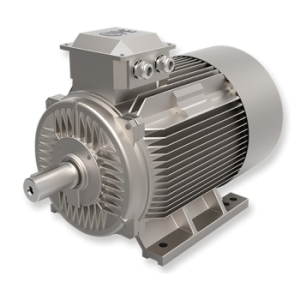
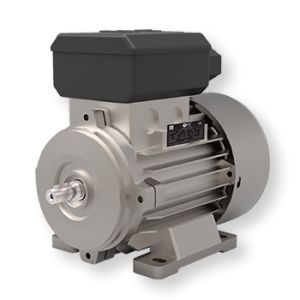
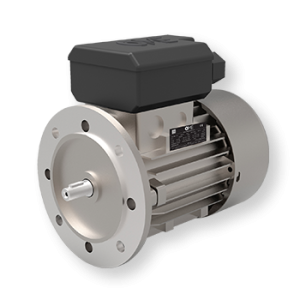
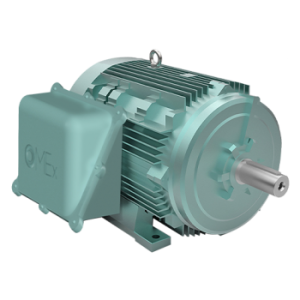
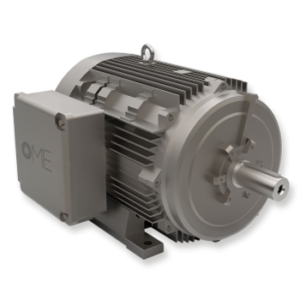
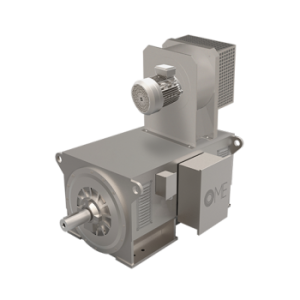
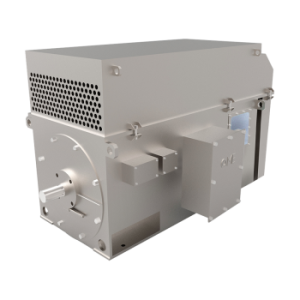
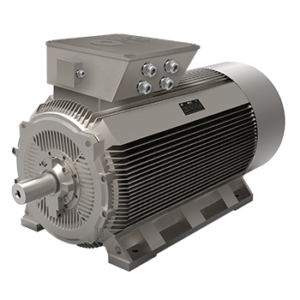

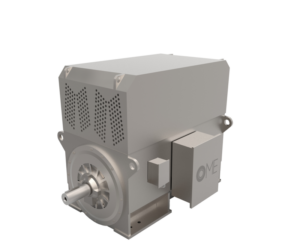
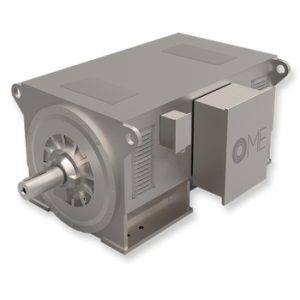
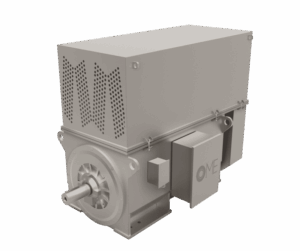
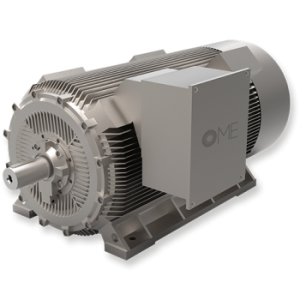
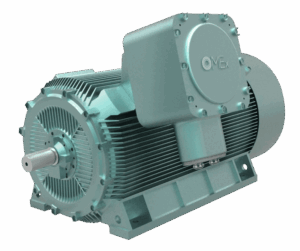
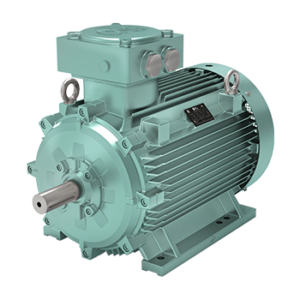

For engineers, procurement managers, and plant operators specifying industrial electric motors on international projects, the choice between NEMA and IEC standards is often the first — and most consequential — technical decision. The two systems govern nearly every physical, electrical, and performance parameter of an industrial motor: frame dimensions, efficiency classes, voltage ratings, enclosure protection, insulation classes. Choosing the wrong standard for a given market means motors that will not fit existing infrastructure, will not comply with local regulations, and cannot be installed without costly retrofit.
OME Motors is one of the few European motor manufacturers producing industrial motors in both NEMA and IEC configurations, allowing customers to specify the correct standard for each destination market — from a single supplier, with matched documentation.
This guide compares NEMA and IEC motor standards across the six dimensions that matter most in industrial procurement.
The two Standards: Origins and governing bodies
NEMA — the National Electrical Manufacturers Association — is the North American standards body. NEMA motor requirements are consolidated in the NEMA MG 1 standard (Motors and Generators), which defines dimensions, ratings, tests, and performance for electric motors used in the United States, Canada, and Mexico. Compliance is de facto mandatory for industrial motors sold into these markets.
IEC — the International Electrotechnical Commission — is the international standards body headquartered in Geneva. IEC motor requirements are governed by the IEC 60034 series, which covers rotating electrical machines across efficiency, cooling, degrees of protection, and dimensions. IEC standards are used across the European Union, most of Asia, South America, the Middle East, Africa, and Australia — the majority of world markets outside North America.
The two systems developed independently over the twentieth century, driven by different voltage systems and manufacturing conventions, and remain non-interchangeable despite ongoing harmonization efforts.
Frame sizes: The dimensional difference
The most visible difference between NEMA and IEC motors is the frame designation system. NEMA frame sizes use a numeric code — 143T, 254T, 445T, and so on — where the number encodes shaft height and mounting dimensions in units of sixteenths of an inch. A NEMA 254T motor has a shaft height of 6.25 inches.
IEC frame sizes use metric dimensions directly. A 132M frame has a shaft height of 132 mm, an M-length body, and a standardized bolt pattern. The IEC system covers frames from 56 (56 mm shaft height) up to 400 and beyond for large motors.
A NEMA 254T motor is roughly equivalent in shaft height to an IEC 160 frame — but the bolt patterns, shaft diameters, keyway dimensions, and terminal box positions do not match. A NEMA-frame motor cannot be drop-in replaced with an IEC-frame motor of equivalent power without foundation modification, coupling changes, or use of an adapter plate.
Efficiency Classes: NEMA Premium vs IE1/IE2/IE3/IE4
Both standards define minimum efficiency levels, but with different labeling and thresholds.
NEMA classifies efficiency in three tiers: Standard Efficiency, Energy Efficient (EPACT), and NEMA Premium — the highest tier, currently mandated by the US Department of Energy under the Energy Policy and Conservation Act (EPCA) for most general-purpose three-phase motors.
IEC uses a numerical ladder defined in IEC 60034-30-1: IE1 (Standard), IE2 (High), IE3 (Premium), IE4 (Super Premium), with IE5 in preparation for specific applications. The European Union mandates minimum IE3 for most industrial motors, with IE4 being the emerging standard for new projects.
NEMA Premium and IE3 efficiency levels are approximately equivalent at full load, though the test methods differ slightly (IEEE 112-B vs IEC 60034-2-1), which can produce measurable differences in nameplate values for the same physical motor.
Voltage and frequency systems
The systems differ fundamentally in the electrical infrastructure they serve.
NEMA motors are designed for 60 Hz operation at 208 V, 230 V, 460 V, 575 V, or 600 V — the standard North American three-phase distribution voltages. Low voltage under NEMA extends up to 600 V.
IEC motors are designed for 50 Hz operation at 230 V, 400 V, 690 V, or higher — the standard European and international distribution voltages. Low voltage under IEC extends up to 1,000 V.
The difference in frequency has direct consequences: a 60 Hz motor operated at 50 Hz runs 17% slower and delivers proportionally less power. A 50 Hz motor operated at 60 Hz runs faster and may overheat unless the voltage is increased proportionally. Dual-frequency 50/60 Hz motors are available from OME Motors for installations spanning multiple regional markets.
Enclosure protection: NEMA Type vs IP Code
Both standards define ingress protection, but with different rating systems.
NEMA enclosures are classified as Type 1 (indoor general purpose), Type 3R (weatherproof), Type 4 (watertight, indoor and outdoor), Type 4X (corrosion-resistant), Type 12 (dust-tight, indoor), Type 7 (Class I hazardous), and Type 9 (Class II hazardous).
IEC enclosures use the IP code — two digits, e.g., IP55, IP65, IP66 — where the first digit rates protection against solid ingress and the second against liquid ingress. IP55 is the industrial standard; IP65 and IP66 are used for outdoor and severe-environment installations.
There is no exact one-to-one conversion: NEMA Type 4 is roughly equivalent to IP66, but the test procedures and certification requirements differ.
Hazardous area certifications
For explosion-proof motors, the systems diverge substantially. NEMA uses the Class/Division system defined by the National Electrical Code (NFPA 70): Class I Div 1, Class I Div 2, and so on. IEC uses the Zone system — Zone 0, Zone 1, Zone 2 — governed by the ATEX Directive in Europe and by IECEx internationally.
OME Motors supplies motors certified under both systems: the OMNEX series of NEMA explosion-proof motors for Class I Div 1 and Div 2 hazardous areas in North America, and the OMEX explosion-proof motor range for ATEX and IECEx installations internationally.
How to choose the right standard
The choice between NEMA and IEC standards should be driven by the installation location, not by supplier preference. Motors installed in the United States, Canada, or Mexico should be NEMA-compliant to meet local codes and integrate with existing infrastructure — particularly UL/CSA listed motors for full regulatory compliance. Motors installed in Europe, Asia, the Middle East, and most other markets should be IEC-compliant.
For multinational projects, EPC contractors often specify both — NEMA for North American package deliveries and IEC for European fabrication — from a single manufacturer to simplify documentation and warranty. OME Motors serves precisely this segment, producing the full range of industrial electric motors in both NEMA and IEC configurations from its Brescia, Italy facility. To discuss standard selection for a specific project, contact the OME Motors engineering team or explore the complete electric motor range.























































 Headquarter - Via Camillo Golgi 8 - 25064 GUSSAGO (BS)