
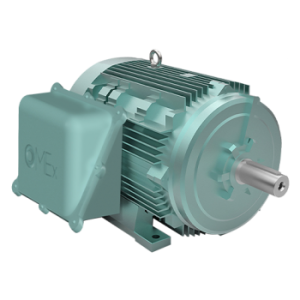
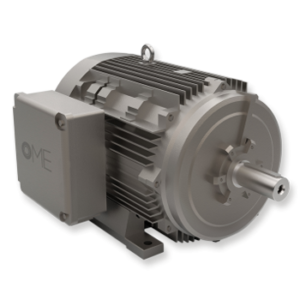
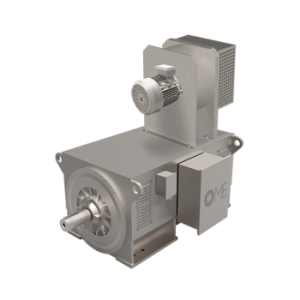
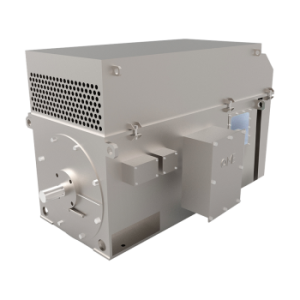
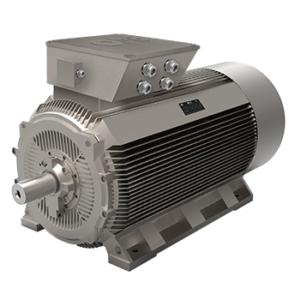

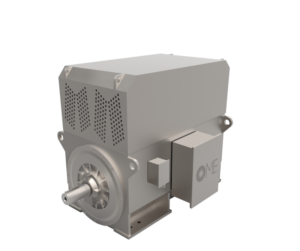
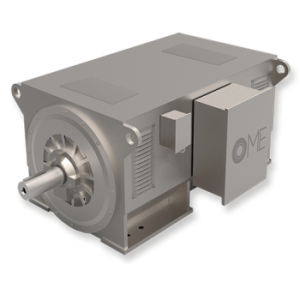
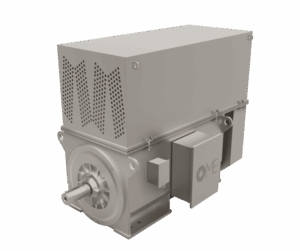
Standard catalog motors serve the majority of industrial applications, but a significant share of projects require something the catalog does not offer: a non-standard voltage winding for an export market, an oversized frame to match legacy equipment on a retrofit, a special shaft end for OEM integration, an unusual protection class for offshore installation, or a combination of certifications for a multi-region delivery. When any of these requirements applies, a custom electric motor is not a luxury, it is the only technically viable option.
AtOME Motors custom motor engineering is not a side activity, it is core to how we work. Every motor produced in our Brescia facility is configured to project-specific requirements, from the winding voltage to the terminal box orientation, from the bearing arrangement to the certification package. This article explains the custom electric motor design process, the technical information required to launch it, the drivers of lead time, and the testing that closes the loop.
When a custom motor design is the right choice
The line between a standard motor and a custom motor manufacturer is not always obvious. Three situations reliably call for custom engineering.
Non-standard supply conditions. A voltage that is not in the standard European or North American range (for example 690 V 60 Hz for an export project, or dual 50/60 Hz for a multi-region installation), a frequency other than 50 or 60 Hz, or grid parameters that differ from any catalog option, all require a custom winding design.
Non-standard mechanical envelope. Replacing an old motor on installed equipment where the foundation, coupling, or terminal box position must match exactly, integrating a motor into an OEM machine with predefined dimensions, or fitting a motor into space-constrained applications, all require custom mechanical design.
Non-standard operational or environmental conditions. Extended ambient temperature ranges (below -20°C or above +40°C), special enclosures for aggressive chemical or coastal environments, integrated instrumentation beyond standard offerings, or hazardous-area certifications combined with other custom features, all require project-specific engineering.
Modification of a standard motor is not the same as custom design. A modified standard is a catalog motor with limited adjustments (paint color, terminal box position, extra sensors); a custom industrial electric motor is engineered from a clean specification with electrical, mechanical, and thermal design verified for the specific application.
The custom electric motor design process
The custom design process at OME Motors follows five sequential steps, each involving electric motor specification input and internal engineering activities.
Step 1: Requirements definition. The customer provides the technical specification (see the checklist below) and the application context. The OME engineering team reviews for completeness, flags missing information, and confirms feasibility within our production envelope.
Step 2: Preliminary design and quotation. Engineering produces a preliminary electromagnetic and mechanical design, verifies power, torque, efficiency and thermal behavior against the specification, and issues a firm quotation with delivery time. This step typically takes 1- 5 working days depending on complexity.
Step 3: Design freeze. Once the customer approves the quotation and any technical clarifications, the design is frozen. Detailed drawings, winding data, and bill of materials are released to production.
Step 4: Manufacturing. Production runs through winding, assembly, impregnation, machining, painting, and final assembly. On custom projects, production lead times range from 6 weeks for straightforward custom low-voltage motors to 24 weeks for large custom high-voltage machines requiring special castings and long-lead components.
Step 5: Testing and delivery. Every custom motor undergoes routine testing per IEC 60034-1 or NEMA MG 1; type tests, witness testing by the customer or a third party, and additional project-specific tests can be added on request. On successful test completion, the motor is documented, packed, and shipped with full certification and traceability documentation.
The technical specification: What to provide
The quality and speed of the custom motor quotation depend directly on the completeness of the technical specification provided at the start. A minimum viable specification includes:
- Rated power (kW or HP) and required service factor
- Rated voltage and frequency (including any dual-voltage or dual-frequency requirement)
- Rated speed or number of poles
- Load profile (constant torque, variable torque, constant power; duty cycle S1 to S10)
- Frame preference (IEC or NEMA, specific frame size if drop-in replacement)
- Enclosure protection class (IP or NEMA rating)
- Ambient temperature range and installation altitude
- Cooling method (IC 01, IC 411, IC 611, IC 81W or others)
- Insulation class (F, H)
- Mounting configuration (foot-mounted, flange, vertical)
- Certifications required (UL/CSA, ATEX, IECEx, API, marine, other)
- Integrated instrumentation (PTC, PT100, encoder, anti-condensation heaters)
- Coupling type and shaft end dimensions if non-standard
- Any specific customer standards or acceptance criteria
For a broader overview of the sizing and selection framework behind these parameters, see the industrial electric motor buying guide.
What drives lead time on custom projects
Custom motor lead times are dominated by three factors. Component sourcing is the largest: large castings, special bearings, and non-standard rotor forgings often carry supplier lead times of 8-16 weeks. Certification and third-party testing adds time when the project requires witnessed testing or new certification issuance rather than reference to an existing certificate. Design complexity matters mainly on unusual configurations where preliminary calculations require iteration with the customer engineering team.
A useful heuristic: standard low-voltage custom motors deliver in 6-10 weeks; permanent magnet and NEMA custom in 10-14 weeks; large custom high-voltage motors in 10-12 weeks on average, extending up to 24 weeks for extremely large motors. Extreme-environment or special-certification projects can extend to 24 weeks or more. OME Motors provides a firm delivery date with every quotation and communicates any changes proactively during production.
Testing and Validation
Every custom electric motor produced by OME Motors is subject to routine tests per the applicable standard (IEC 60034-1 for IEC production, NEMA MG 1 for NEMA production). On request, we perform additional type tests, temperature rise tests, vibration and noise measurement, efficiency verification, and witnessed testing with customer or third-party inspectors present at the Brescia facility. Full test certificates are issued for every unit.
For any custom electric motor design project, contact the OME Motors engineering team or explore the full Industrial electric motors range as a starting point for defining your requirements.































































 Headquarter - Via Camillo Golgi 8 - 25064 GUSSAGO (BS)